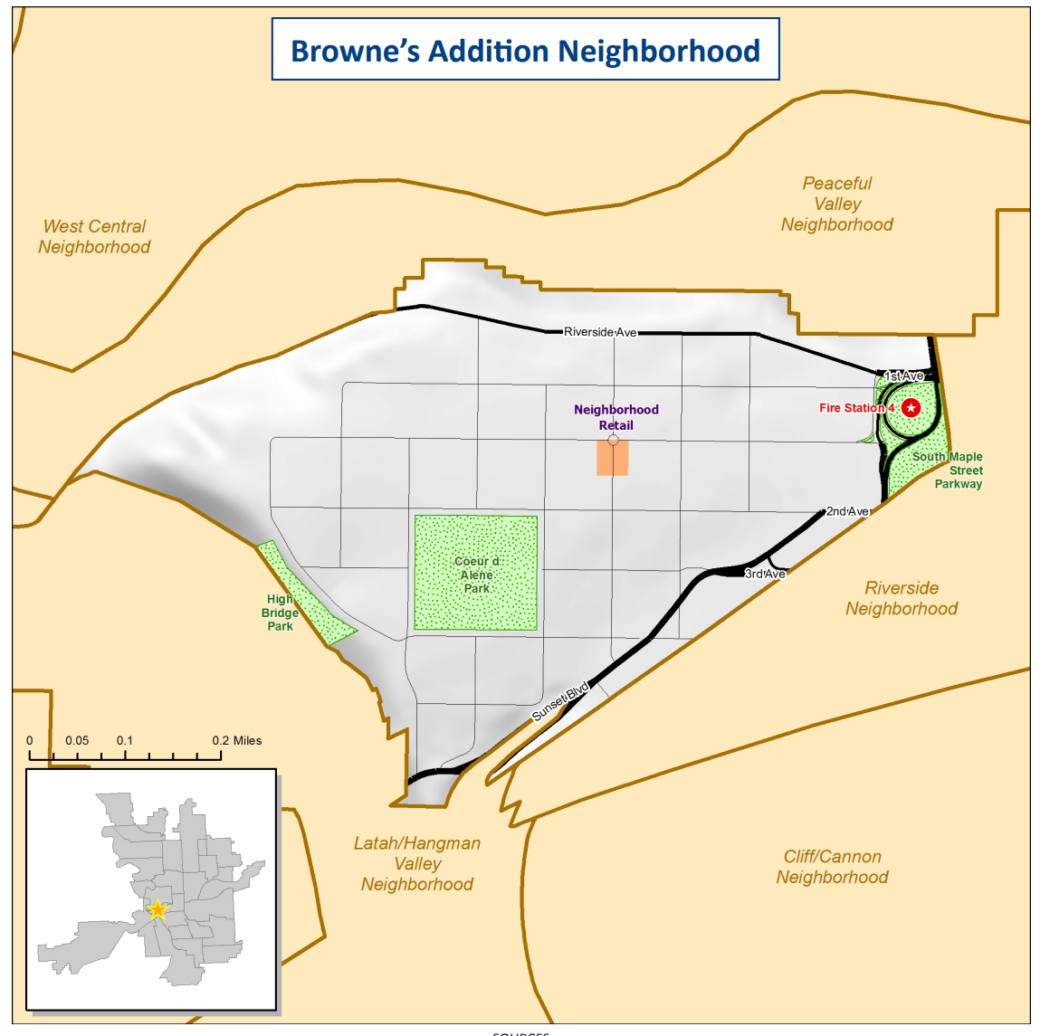
Looking to the Past: In 1878, two men, J J Browne and A M Cannon, arrived in Spokane Falls looking for adventure and fortune. They saw the potential of the raging river and the natural resources to support a larger population than the 54 hearty pioneers that inhabited the little town. They decided to invest. With a down payment of $50, they bought ¼ of the Spokane Falls town site from James Glover, the founding father of Spokane. Later on, they each laid claim to 160 adjoining acres west of town for development as Browne’s Addition and Cannon Addition.
By 1880, the population had grown to 350 people. The plethora of Chinese railroad laborers and servants were not included in that number. In spite of tremendous racial enmity toward Asians, the Chinese had an important role in Spokane and in Browne’s Addition. Their cemetery was situated at the west end of the neighborhood, overlooking the confluence of Latah Creek and the Spokane River. Chinese funerals brought a parade of Chinese through Browne’s Addition with their noise-makers and bright colorful banners to scare away evil spirits. The bodies were later exhumed and sent to China, leaving behind the only vacant lot in the neighborhood, at the end of Pacific Avenue.
The Northern Pacific Railroad reached Spokane Falls in 1881 and by the end of that year, the population had grown to 1,000. By 1883, Browne and Cannon had platted their land and were selling lots. They set aside almost 10 acres straddling their adjoining land for a park. In 1891, Coeur d’Alene Park in Browne’s Addition became the first park in the growing city of Spokane. The neighborhood was on its way to becoming a highly desirable and prestigious residential community.
Throughout the eras of history from then until now, Browne’s Addition has mirrored the development of Spokane in its architecture and residents. In the early years, families moved into Queen Anne and Folk Victorian style houses. They were often built from blueprints and instructions that could be easily purchased. After the big fires of 1889 until the turn of the 20th century, the economic growth of the city was reflected in the many architect-designed houses. With the continued building boom, brought on by entrepreneurs in successful lumber, real estate, and mining ventures, wealthy homeowners commissioned leading architects and builders to design and erect opulent homes and carriage houses in a variety of styles — Colonial, Tudor Revival, Neoclassical, Craftsman, and Mission Revival. Such first-rate architects as Kirtland Cutter, W.J. Carpenter, Albert Held and Loren Rand showcased their talent in architectural wonders from traditional to exotic eclectic interpretations. Following the frenetic building of extravagant mansions, after the turn of the century, smaller houses and luxury apartments were built throughout the neighborhood. The Westminster, built in 1905, became the largest luxury apartment block in the area with large suites, rooms for the families’ servants and a formal dining room. Before the Great Depression, Browne’s Addition was the place to live.
From the 1930s to the 1980s, many residences were demolished to make way for smaller dwellings and modern commercial intrusions. Many of the elegant mansions were altered as apartment houses. The neighborhood became run down and crime was rampant. The 1980s and 1990s brought a resurgence of community interest when a small group of residents formed the Browne’s Addition Steering Committee. With the influx of money from the city’s Neighborhood Community Development Program and other federal monies, the Steering Committee worked with the city to prepare a “Browne’s Addition Design Plan” which mapped out a strategy for neighborhood identity.
Many of the historic houses were rehabilitated; a traffic circle was constructed in the middle of the small business intersection; and, a gazebo was built in the park, using the original design from the one built in the early part of the century. The Victorian theme from an earlier era is evident in lights and street signs. This renewal brought a re-energized interest in historic preservation and education as the 21st century approached.